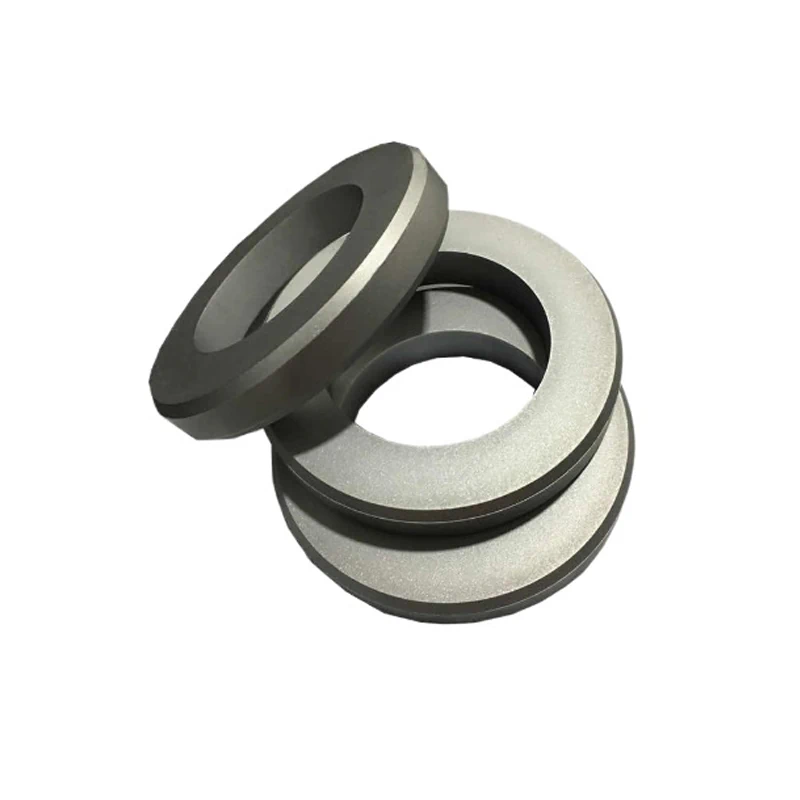


The Secret Ingredients Behind the World's Hardest Materials: How We Make Tungsten Carbide Even STRONGER
Tungsten carbide is already one of the hardest materials on Earth. But engineers have figured out how to push it even further. The secret is tiny amounts of carefully selected additives that most people have never heard of.
In this article we break down the science behind these secret ingredients and show you exactly how they work.
The Foundation: Understanding Tungsten Carbide
Before we dive into the additives, let’s understand the base material.
Think of tungsten carbide like reinforced concrete. Hard carbide particles are the stones, and cobalt binder is the cement that holds everything together. This simple combination gives us exceptional hardness and wear resistance. But the real breakthroughs come from what you add on top of it.
The Grain Guardians: Vanadium and Chromium
Why Grain Size Matters
In materials science, size truly matters. Large grains make the material brittle, weak, and prone to cracking. Small grains deliver exceptional hardness and superior wear resistance.
The goal is to keep those grains as small as possible. But during the high-heat manufacturing process called sintering, grains naturally want to grow larger. That is where our bodyguards come in.
Vanadium: The Number One Bodyguard
Vanadium sits at the grain boundaries and prevents them from moving and coarsening during sintering. It forms stable carbides that pin grain boundaries in place. The result is a fine, uniform microstructure that delivers maximum hardness.
Chromium: The Reliable Backup
Chromium plays a similar role to vanadium but with an added bonus. It also improves corrosion resistance. Together, vanadium and chromium are the foundation of grain control in high-performance cemented carbides.
The Heat Armor: Tantalum and Niobium
What Is Red Hardness
Red hardness refers to a material’s ability to maintain its hardness even when glowing red-hot. For high-speed, heavy-duty cutting tools, this is not a nice-to-have feature. It is a matter of survival.
During aggressive machining operations, the cutting edge can reach temperatures of 800 to 1000 degrees Celsius. At these temperatures, the cobalt binder naturally starts to soften. Without protection, your cutting edge turns to mush mid-operation.
How Tantalum and Niobium Save the Day
Tantalum and niobium act like thermal armor for the cobalt binder. They form solid solutions with the cobalt phase, strengthening it at high temperatures. They create stable carbides that resist thermal degradation and maintain structural integrity when other materials would fail.
Think of them as a heat shield that keeps the glue strong even when everything around it is melting.
The Specialists: Solving Specific Problems
Not all additives are generalists. Some are brought in as specialists to solve very specific challenges.
Titanium: The Anti-Stick Expert
When cutting steel at high speeds, metal chips can weld themselves to the cutting tool surface. This built-up edge destroys tool life and ruins surface finish.
Titanium forms an ultra-thin protective layer on the tool surface, essentially creating a non-stick pan for metal chips. This layer prevents adhesion, reduces friction, and dramatically extends tool life in steel machining applications.
Chromium: The Corrosion Fighter
In harsh chemical environments like chemical processing plants or marine applications, corrosion is a major enemy. Chromium forms a passive oxide layer that protects the material from acidic environments, oxidation at elevated temperatures, and general chemical attack.
Nickel: The Cost-Effective Alternative
Nickel can replace expensive cobalt as the binder phase while offering superior corrosion resistance, better performance in magnetic applications, and lower material costs. It is the budget-friendly option that does not compromise on quality.
The Industrial Vitamins: Rare Earth Elements
This is where things get truly fascinating.
Rare earth elements, specifically yttrium, cerium, and lanthanum, are added in quantities of less than one percent. Yet their impact is transformative.
Why Industrial Vitamins
Just like vitamins in the human body, you only need a tiny amount, but the benefits are system-wide.
First, rare earth elements migrate to grain boundaries and clean out impurities. These impurities act like weak points in the material structure. Removing them strengthens the entire matrix.
Second, they improve the wetting and bonding between carbide particles and the metal binder. Think of it as upgrading from regular glue to industrial-strength epoxy.
Third, as an added benefit, rare earths also help inhibit grain growth, working alongside vanadium and chromium to keep that microstructure fine and strong.
The result is a dramatic leap in fracture toughness, which is the material’s ability to resist cracking and chipping, without sacrificing the hardness that makes tungsten carbide special in the first place.
The Real Secret: It Is Never Just One Hero
Here is the most important insight from this entire article. The world’s best material scientists do not rely on a single additive. They are master mixologists.
They blend vanadium, chromium, tantalum, titanium, and rare earth elements in precise ratios to create a performance cocktail tailored to brutally specific applications.
Real-World Application Mapping
Micro-drills for electronics use vanadium for maximum grain control and precision.
High-speed heavy cutting uses tantalum and niobium for thermal stability under extreme heat.
Steel machining uses titanium for anti-adhesion and anti-sticking properties.
Corrosive environments use chromium and nickel for chemical resistance.
Extreme toughness demands use rare earth elements for overall structural reinforcement.
This is why you will not find a one-size-fits-all tungsten carbide grade. Every application demands its own carefully engineered recipe.
Looking Ahead: What Is Next
Everything we have discussed represents today’s technology. But the world is moving fast.
Additive manufacturing, or 3D printing, of cemented carbides is opening new design possibilities. Nanostructured materials are pushing grain sizes to previously impossible limits. AI-driven materials discovery is accelerating the search for new additive combinations.
As machines get faster, hotter, and more demanding, the question becomes: what undiscovered secret ingredients will the next generation of material scientists unlock?
Conclusion
Tungsten carbide is not just hard. It is a platform, a foundation that engineers can tune and optimize through carefully selected additives.
From vanadium’s grain-guarding power to rare earth elements’ system-wide benefits, each additive plays a critical role. And the real magic happens when they are combined in precisely calibrated recipes.
The next time you see a cutting tool performing flawlessly under extreme conditions, remember there is an entire team of invisible superheroes working behind the scenes.
About the Author
This article was written for professionals and enthusiasts in the materials science, manufacturing, and engineering communities. For inquiries about custom carbide solutions, feel free to reach out.